

Why Winter Prep Matters in Illinois
Protect your kayak all winter in Illinois with this research-based guide to cleaning, drying, indoor/outdoor setups, UV/pest control, proper supports, and spring prep. By the time fall gives way to freezing temperatures, Illinois paddlers know the Fox River is no place for casual trips. But your kayak still needs care long after the last paddle. Cold, moisture, pests, and UV exposure can quietly ruin a hull or fittings during the off-season. With a simple plan, you can keep your boat ready for spring.
Table of Contents
Why a winter plan matters in Illinois
Illinois winters swing between freeze‑thaw cycles, lake‑effect moisture, and long stretches of sub‑freezing temps. Those conditions can deform hulls, encourage mildew, chalk plastics via UV exposure, and invite pests into dark, enclosed spaces if boats are put away wet. A clear plan protects the hull, outfitting, and hardware so your kayak is ready when Fox River conditions warm up again [1], [2].
What this guide delivers: a practical checklist, indoor and outdoor setups, material‑specific advice, garage/small‑space solutions, pest/UV/moisture control, and a quick spring reactivation list—grounded in manufacturer and paddling‑safety guidance [1]–[6].
Kayak winter storage checklist for Illinois
- Clean: Rinse hull, cockpit, and hatches with fresh water; use mild soap on grime. Flush all sand and silt from seat tracks, skegs/rudders, and foot braces [1], [4], [6].
- Dry: Air‑dry completely—cockpit and hatches propped open—before any cover goes on to prevent mildew and corrosion [1], [5].
- Remove soft goods: Take out removable seats, float bags, bilge sponges, and damp lines to dry indoors.
- Loosen straps & hardware: Slightly back off foot‑brace tension; lubricate metal where the manufacturer recommends (avoid petroleum on some plastics) [6], [13].
- Support the hull: Use two wide, padded supports or slings placed roughly 30%–40% of the boat length from each end; avoid point loads and hanging by toggle/side handles [1], [11].
- Position: Store on its side or deck‑down (for many models) on padded supports; avoid long‑term flat‑hull pressure (“oil canning”) [1], [10], [11].
- Protect: Shield from sunlight, moisture, and temperature extremes; use a breathable cover and maintain airflow [1], [5].
- Pest control: Seal food smells out, keep a breathable cockpit cover on, and use moisture absorbers in hatches where appropriate [5].
- Outdoor? Elevate off the ground, tilt for drainage, and lash the boat against wind.
Clean and dry: the no‑skip steps
Why clean now: Dirt holds moisture; salt and organic debris accelerate corrosion and mildew. Wash with fresh water and mild soap; avoid harsh solvents that can attack plastics, adhesives, and sealants [1], [6].
Drying thoroughly: Leave hatches open and the cockpit uncovered for 24–48 hours in a ventilated spot. A small fan can speed evaporation; moisture absorbers inside sealed hatches can help once everything is dry [5].
Hardware check: Work moving parts—rudder/skeg, foot braces, backbands—then dry. Apply manufacturer‑approved lube to metal pivots or cables if specified (composites and ABS often require gentler cleaners) [6], [13].
Where to keep it: indoor, sheltered, or outside
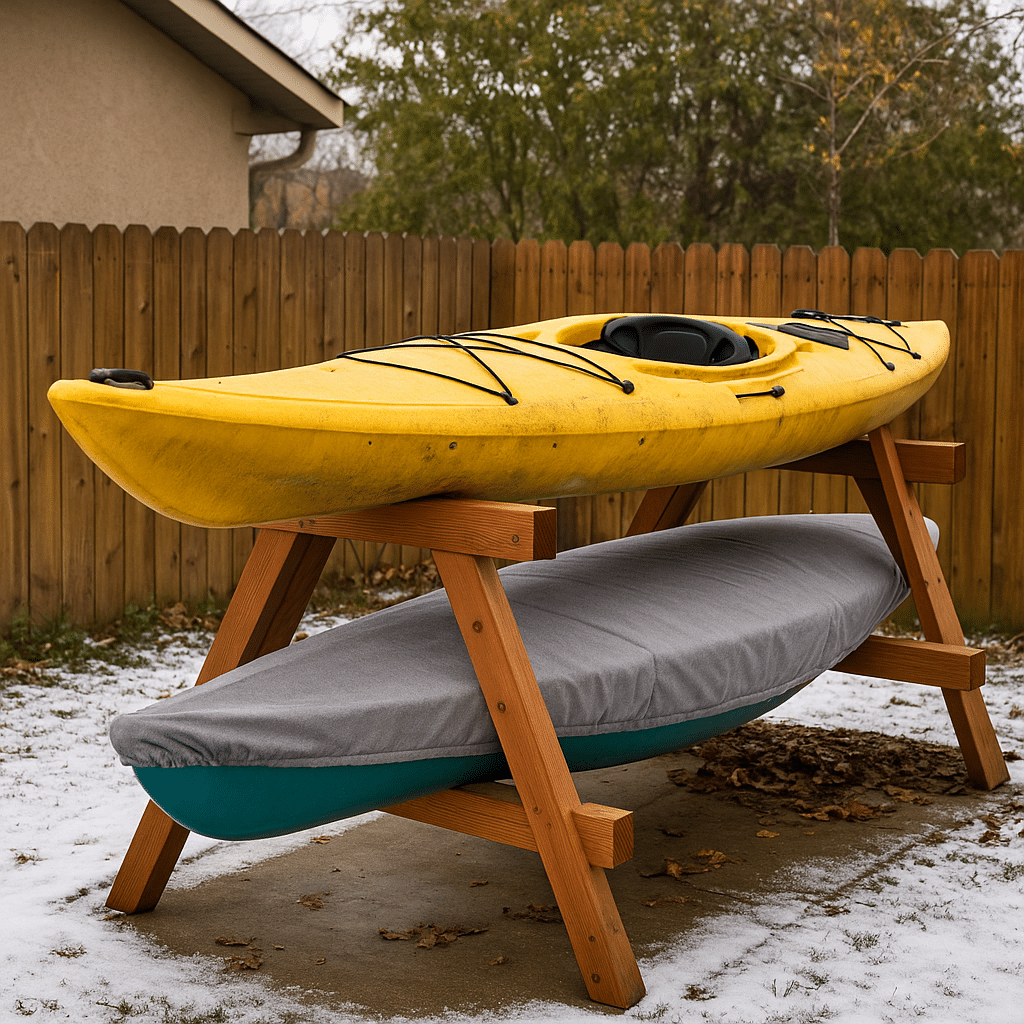
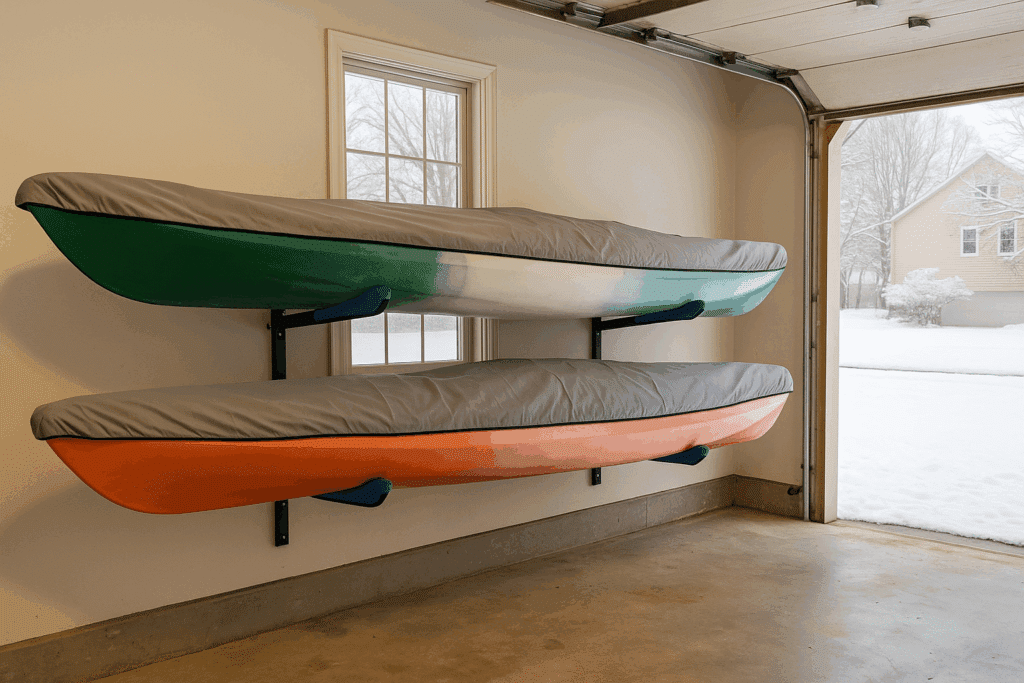
Best‑case: Temperature‑stable, dark, dry space (garage, basement, utility room). This reduces UV damage, moisture, and thermal cycling—three primary stressors for hulls and outfitting [1].
Sheltered spaces: Carports, sheds, or covered porches keep precipitation off; still use a breathable cover and airflow underneath.
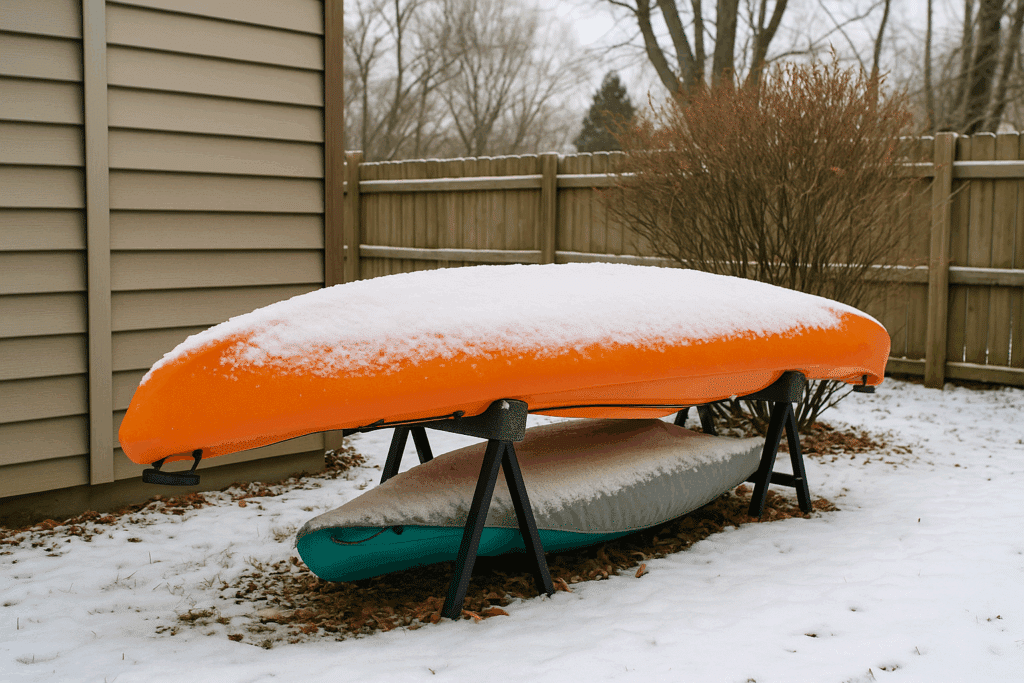
Outdoors: Completely viable if you elevate the kayak, avoid direct sun, use a breathable cover, and allow ventilation. Angle slightly so rain/snowmelt drains away from the cockpit/hatches; secure with straps to deter wind [1], [2], [12].
Supports and hull shape (avoiding “oil‑canning”)
Rotomolded boats are tough, but long‑term point loads can flatten sections of the hull. Distribute weight with two wide, padded cradles or slings positioned roughly a third of the way in from each end, or store on the side/deck depending on your manufacturer’s guidance [1], [10], [11]. Avoid tight straps that compress plastic in cold temperatures—plastic can “remember” deformations over time [1], [2]. If you notice a slight flat spot in spring, warm‑weather paddling usually lets the plastic relax.
UV, moisture, and pests—your three silent enemies
- UV: Even winter sun degrades polymers. Shade, indoor storage, and UV‑protective sprays recommended by your manufacturer help reduce chalking and brittleness [1], [2].
- Moisture: Trapped humidity breeds mildew and can corrode fasteners. Dry first, then use breathable covers and keep some airflow; avoid wrapping in non‑breathable plastic [1], [5].
- Pests: Food scents attract mice. Remove snacks, dry bags, and sponges; use tight cockpit covers and keep surrounding storage areas tidy. Moisture absorbers (or odor absorbers) inside dry hatches can reduce mustiness [5].
Sit‑inside vs. sit‑on‑top: setup differences
Sit‑inside:
- Store with cockpit covered after drying.
- Crack hatch lids to vent while drying, then close loosely for storage.
- Keep bulkhead areas supported (where present) to distribute loads [1], [11].
Sit‑on‑top:
- Ensure all scuppers and drain paths are clear; tilt the boat so water cannot pool.
- Many manufacturers prefer side or deck‑down storage on padded cradles; avoid slinging by bow/stern toggles [1], [2], [11].
Material‑specific advice (poly, thermoform, composite)
Rotomolded polyethylene (most rentals/recreation boats): Durable but prone to pressure dents if left on flat racks or tight straps. Favor padded slings/cradles and side storage; avoid heat sources and direct sun [1], [2].
Thermoform ABS (Eddyline/Delta, etc.): Lighter and stiffer; use broad supports and avoid point loading; clean with manufacturer‑approved products; many brands recommend gentle cleaners (Novus/Armor All equivalents) and careful hatch‑gasket care [5], [6], [13].
Composite (fiberglass/kevlar/carbon): Strong and shape‑stable; avoid narrow straps that can imprint the gel coat. Side storage in padded cradles works well; keep out of UV and extreme temperature swings [1], [4].
Garage and small‑space solutions that work
- Wall cradles mounted into studs at two points (spaced ~30%–40% from the ends) with wide padding [1], [11], [12].
- Free‑standing racks for renters/landlords who can’t drill.
- Ceiling hoists for tall garages—lower onto padded slings to distribute load [2], [12].
- Vertical storage (bow up) only if the stern sits on thick padding and the side is gently tied back; avoid compressing rudder/skeg assemblies [1].
Outdoor setups that survive Midwest winters
If inside space is tight, a simple outdoor rig is reliable and inexpensive:
- Two 4×4 posts with cross‑arms or a small treated‑wood rack.
- Two wide, padded slings or arms; position to spread load.
- Breathable, fitted cover that doesn’t trap moisture; leave a hand‑sized vent gap underneath.
- Tilt slightly so rain/snow drains; keep scuppers/drains clear.
- Lash the boat to the rack with wide straps; avoid over‑tightening in freezing temps [1], [2], [12].
Quick maintenance to do before you walk away
- Check deck lines, bungees, and rudder/skeg cables for wear; replace tired lines now so you’re not chasing parts in spring.
- Dab stainless hardware with manufacturer‑approved protectant; avoid products that attack plastics or elastomers [6].
- Photograph the boat once racked—handy for spring re‑rigging and insurance.
Spring reactivation checklist (10‑minute version)
- Remove cover, inspect hull and outfitting.
- Reinstall/retension seat, foot braces, and deck lines.
- Test rudder/skeg movement; lube pivots if specified by the brand.
- Rinse dust/pollen; apply UV protectant only if your manufacturer recommends it.
- Safety refresh: check PFDs, paddles, bilge pumps, float bags.
- Local compliance: review Illinois boating safety updates and refresh your float plan habits [14].
- Early‑season water is cold—if you do shoulder‑season paddling, dress for immersion (wetsuit/drysuit) and wear your PFD; cold shock is real and can occur at relatively warm air temps when the water stays cold [7], [8], [9], [10].
Cold‑weather note for late‑season paddlers
If you do get a warm spell and decide to paddle into November, dress for the water, not the air: immersion protection, gloves/booties, and a PFD every time. Cold shock can begin at surprisingly mild water temps; hypothermia risk rises quickly after immersion—plan conservative distances, paddle with a partner, and file a float plan [7], [8], [9].
Key Takeaways
- Dry, shade, ventilation, and broad padded supports beat everything else for long‑term hull health [1], [2], [11].
- Side or deck‑down storage on two wide cradles helps prevent “oil‑canning” [1], [10], [11].
- Outdoor is fine if elevated, covered breathably, tilted for drainage, and lashed for wind [1], [12].
- Material matters: follow manufacturer care notes for ABS/composite vs. rotomolded [5], [6], [13].
- Shoulder‑season paddling requires immersion‑rated clothing and a PFD; cold shock and hypothermia remain risks well into spring [7], [8].
References
- REI Co-op. “How to Store a Kayak: Tips & Solutions.” https://www.rei.com/learn/expert-advice/kayak-storage.html
- Old Town. “The Ultimate Kayak Storage Guide.” https://oldtownwatercraft.johnsonoutdoors.com/us/blog/ultimate-kayak-storage-guide
- Old Town. “How to Properly Store a Sit On Top Kayak.” https://oldtownwatercraft.johnsonoutdoors.com/us/blog/how-properly-store-sit-top-kayak
- Paddling.com. “How to Store Your Kayak Between Paddling Trips.” https://paddling.com/learn/how-to-store-your-kayak-in-between-paddling-trips
- Delta Kayaks. “Winter Storage Tips.” https://www.deltakayaks.com/winter-storage-tips/
- Eddyline. “Kayak Care and Repair.” https://eddyline.com/blogs/news/kayak-care-and-repair
- U.S. Coast Guard. “Cold Water Survival & Hypothermia.” https://www.dco.uscg.mil/Portals/9/DCO%20Documents/5p/CG-5PC/CG-CVC/CVC3/notice/flyers/Cold_Water_Survival_Hypothermia.pdf
- National Weather Service. “Cold Water Hazards and Safety.” https://www.weather.gov/safety/coldwater
- Illinois DNR. “Boating Safety.” https://dnr.illinois.gov/safety/boatingsafety.html
- Old Town. “Owner’s Manual.” https://oldtownwatercraft.johnsonoutdoors.com/sites/default/files/2022-12/oldtowncanoe_owners_manual_web.pdf
- Old Town. “Frequently Asked Questions.” https://oldtownwatercraft.johnsonoutdoors.com/us/frequently-asked-questions
- Paddling.com. “Kayak Storage Ideas For The Off-Season.” https://paddling.com/learn/kayak-storage-ideas
- Delta Kayaks. “Owner’s Manual (Care & Storage).” https://www.deltakayaks.com/wp-content/uploads/2018/10/2018-delta-kayaks-owners-manual.pdf
